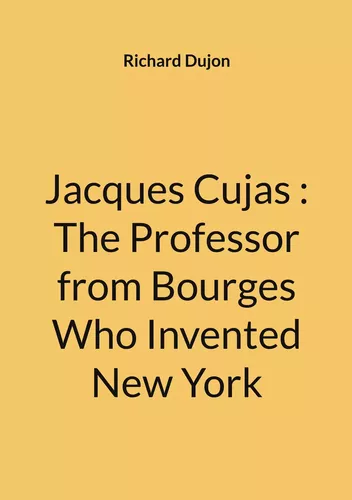
Jacques Cujas: The Professor from Bourges Who Invented New York
What if the foundations of Manhattan were not made of stone, but of paper and law?
In 1590, Jacques Cujas passed away in Bourges. This genius of Roman law left behind a silent revolution: the mos gallicus, a method of critical reading that rejected dogmas in favor of returning to the original sources. Little did he know that this intellectual spark would one day cross the oceans.
From the persecution of the Huguenots to the lecture halls of Leiden University, this book retraces the incredible journey of an idea. It follows the dynasty of the Dujon and Vossius families - those "conveyors" of knowledge who transformed humanist erudition into a tool for global governance. It was this very rigor, inherited from French academic chairs, that allowed the Dutch to conceive of New Amsterdam not as a military conquest, but as a contract.
Through a fascinating historical investigation, Richard Dujon reveals that New York is the distant daughter of Bourges. A city born from an archive, built on law and commerce, where modernity was invented through the reading of a text.
A masterful narrative on the invisible power of ideas, redrawing the genealogy of our modern world.
Richard Dujon est un chercheur base en Auvergne-Rhone-Alpes, France. Il est actif dans la recherche en histoire, sciences, nouvelles technologies, et developpement durable.







Il n'y a pour le moment pas de critique presse.