
Skip to the end of the images gallery Nav bascule
Skip to the beginning of the images gallery Nav bascule
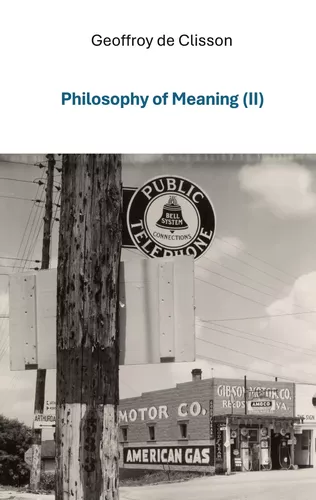
Philosophy of Meaning II
Tome 2 : Philosophy of Meaning
ePUB
2,6 MB
DRM : pas de protection
ISBN : 9782322666829
Éditeur : BoD - Books on Demand
Date de parution : 05.04.2025
Langue : anglais
Accessibilité: Accès limité
Disponible en :
1,49 €
TVA incluse
Téléchargement disponible dès maintenant
Votre propre livre !
Devenez auteur avec BoD et vendez votre livre et votre ebook en librairie.
En savoir plusThe philosophy of meaning is structured around four main axes: knowledge, aesthetics, ethics, and identity. By engaging with the question of the emergence of consciousness, it examines the logical limits of materialism and reductionism, and offers a critique of physicalist monism in favor of a reimagined dualism -one grounded in the discontinuity between matter and meaning, a discontinuity that alone makes possible the emergence of objective discourse.
At the heart of this approach lies the idea of an original openness of being to the world - a silent exposure to what is external to it, preceding language, logic, and any form of representation. Three central dimensions of experience can thus be explored on the basis of this primordial structure: aesthetics, through music, as an immediate access to the articulation between the sensible and the significant; ethics, as a fundamental questioning of the relationship to otherness that precedes the normative concerns of morality; and identity, conceived as a dynamic dialectic between openness and the gathering of being. These domains are not separate fields, but each, in its own mode, expresses the structure of a radical dualism- the condition for any formal production, any act of thought, and any possibility of understanding the world.
Underlying it all is an attempt to reconcile science and humanism through a philosophy of form, freedom, and spirit.
At the heart of this approach lies the idea of an original openness of being to the world - a silent exposure to what is external to it, preceding language, logic, and any form of representation. Three central dimensions of experience can thus be explored on the basis of this primordial structure: aesthetics, through music, as an immediate access to the articulation between the sensible and the significant; ethics, as a fundamental questioning of the relationship to otherness that precedes the normative concerns of morality; and identity, conceived as a dynamic dialectic between openness and the gathering of being. These domains are not separate fields, but each, in its own mode, expresses the structure of a radical dualism- the condition for any formal production, any act of thought, and any possibility of understanding the world.
Underlying it all is an attempt to reconcile science and humanism through a philosophy of form, freedom, and spirit.

Rédigez votre propre commentaire



Il n'y a pour le moment pas de critique presse.