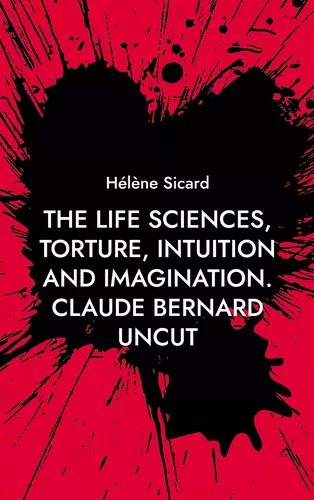
Focused on the life and work of the founder of modern experimental medicine, namely nineteenth-century French physiologist and playwright Claude Bernard, this essay gives its readers reasonable ground to consider the institutionalization of the experimental method as sole method of scientific inquiry in the life sciences as being perhaps one of the greatest deceptions in the history of modern medicine.
As a matter of fact, the author's non-selective reading of Bernard's scientific writings reveals that the latter dismissed scientific experimentation on the living, which he called "vivisection," because it was "torture," in his own word, and because it could easily be avoided, since human beings can rely on soft, self-sufficient means of accessing knowledge such as intuition, imagination and dreams, according to him.
Sicard's essay attempts to make sense of Bernard's enigmatic choice to carry out experiments anyway, which he considered as a form of creative writing, while striving to understand why violence, and specifically torture, persists in most areas of human activity in today's society.
Hélène Sicard is an established independent scholar with a Ph.D. in French Literature who specializes in the critical medical humanities, critical animal studies, and post-colonial/de-colonial studies. She holds a Ph.D. in French Literature from UC-Berkeley. She taught at numerous institutions of higher education in North America and Europe, including McGill University and the University of Iowa. She currently works for a non-profit in Iowa City.









Il n'y a pour le moment pas de critique presse.